vendredi 3 février 2017

The Roman Medecine, Part 3

Medecine and Greco-Roman mythology

As in most of the disciplines that they practise on a daily basis, Romain connect several gods with the medicine, especially as it was perceived for a long time by them as something being only of the religion and the superstitions. The god of the medicine strictly speaking is the same at the Greeks or at Romain, the simply named in a different way: Asclepius / Aesculapius. 

Esculape is thus a specific god in the medicine and in the health (besides the medicine, the god Apollo possesses diverse attributes which make that he is not exclusively the god of the medicine).

The legend of Esculape

There are several legends around the character of Asclepius, but I am going to mention only the most known. Asclepius is thus the son of the god Apollo and of the mortal Coronis his mistress. When her mother is pregnant of him, she deceives Apollo with an other one mortal of the name of Ischys, a prince of Arcadia. Apollo does not delay learning the infidelity of Coronis: a white crow comes to announce it to him. In his anger, the god colors with black his feathers. Diane, twin sister of Apollo, punishes the unfaithful by killing her of one of her arrows. Apollo takes care personally of Ischys. But the god realizes that Coronis was pregnant: he thus extracts the baby, Asclepius, from the stomach of his ex-mistress sacrificed on the funeral stake.

Asclepius is entrusted to the centaur Chiron asked to take care of his education. This centaur, excellent teacher, having learnt the medicine of Apollo, transmits himself his medical knowledge to the child. So, Asclepius reaches a high level in the practice of the medicine: he knows how to prepare medicine, potions and ointments, but also use the surgery or recognize the plants which allow to cure. The goddess Athena offers to Asclepius a particular blood: that of the Gorgon Meduse. it confers him the power of life and death on whoever. He uses it frequently to resuscitate mythological characters. However, Hades does not see it of a good eye: as god of Hell, he becomes alarmed to see that the deaths are more and more rare. Zeus remedies it in a radical way: he eliminates Asclepius by using the lightning of Cyclopses. Apollo, naturally saddened by the death of his son, eliminates in return the Cyclopses. For this crime, Zeus condemns him to serve king Admetus of Epirus in slave. Zeus decides nevertheless to make Asclepius be reborn as immortal god of the Medicine, a completely friendly god and quack, very popular in the Greek and Roman peoples.

The worship of Asclepius

The cult of the god Asclepius appeared, from the classic age, in Greece. It is admitted that the first temple ( Asklepeion) which is dedicated to him is in the city of Trikkala, in the Thessaly. There is also Asklepeion to Pergame, the home town of Galius, as well as in Athens and to Cos. But the big center of the worship of Asclépios is localized to Epidaurus, place of birth supposed by the god. In 293 b. J. C., after a terrible epidemic of plague, is built the first Roman temple dedicated to the god Asclepius, on the island of the Tiber. The visitors of the temple hope most of the time for the cure of a disease. To do it, they have to cleanse themselves (fast, diet), then, entered the sanctuary browsed by not venomous snakes symbols of the god, to sleep inside: the god Asclepius intervenes in their dreams to give them the procedure. So the god is sensible to practise the medicine by "incubation". A sick person cured of its evil thanks the god by making him offering of a votive relief (relief offered to a god in sign of Gratitude). Sometimes the access to the temple is paying.

The Attributes of Asclepius

As all the gods were the most worshipped by the roman time, Asclepius possesses particular attributes. The most known by these attributes is his favorite animal, the snake, to such a point that a sort of snakes (not venomous) is called snake of Asclepius. This animal is by his side in almost all the representations of the god. Fast, very agile and endowed with a very good appetite, this snake possesses all the qualities to embody the health. Furthermore, the regular metamorphosis of the reptile symbolizes the regeneration of the life. 
As seen previously, inside Asclepius Epidaurus's sanctuary are several snakes of this type. Other one of the animals of preference of Asclepius is the mole. It is possible that in its oldest shape, Asclepius was a "god-mole". Even more connected with the earth  than the snake, the mole can most probably be one of the attributes of Esculape. There is another third animal connected to Asclepius, it is about the cock. This gallinacean symbolizes the day renewal. The sick cured by the god of the medicine sacrifice him generally a cock.

Iconography of Asclepius

The iconography is a study of the various representations of a person, an object... 

Asclepius is often represented at Roman, very often under the shape of a sculpture. Old, the god remains by means of a stick all around of which is tangled up a snake. He possesses a long beard. Sometimes, his daughter Salus and Panacea and his son Telesphoros accompany him.

The family of Asclepius

The god Asclepius has a wife, Epione, a girl of king of Cos, and not less than seven children, among whom four girls and three sons: Panacea, Salus, Iaso, Aglaea, Machao, Polidarius and Telesphoros.

-Panacea is the goddess of the universal Cure.
-Salus, relatively important character of the medicine, is the goddess of the health, of the cleanliness and the hygiene (this last term was formed from its Greek name, Hygieia).
-Iaso is the Quack.
-Machaon and Polidarius become famous during the Trojan War during which they behave as real heroes quacks just like their father.
-Finally, Telesphoros is the god of the convalescence. Which is the state of a person who recovers of a disease.

The "snake of Asclepius" in certain emblems

The snake, the emblem of Asclepius, is widely associated with the medicine today and is used to symbolize the medical professions through the caduceus of the order of the Doctors of France for example. But the snake of Asclepius is a part of other emblems of medical professions: so the emblem of the Pharmacists consists of a snake of Asclepius getting entangled around a cup of Hygieia. Replace the cup of Hygieia by a microscope, a diapason or an egg-shaped shape and you will obtain respectively emblems of analysis laboratories medical, hearing-aid specialists and midwives. The mirror which sometimes appears on these symbols represents the caution necessary for this kind of job.



Other divinities attached to the medicine

Esculape, his children and his father Apollon are not the only gods who concern the medicine: indeed, minor, very specialized and often local divinities, are worshipped in the Roman territory.

Here are some of these divinities:

-Angitia, goddess of the Cure and the Witchcraft, more particularly known in the center of Italy.
-Carna, protective divinity of the body, the internal organs in particula.
-Clitumnus, divinity quack of Umbria.
-Endovelicus, god of the Health and the Spanish and Portuguese Well-being, joined into the Roman mythology after the conquest of the Iberian Peninsula by Romans.
-Febris, protective goddess fighting against the fever and against the malaria.
-Veiovis, Etruscan goddess bound to the health.
-Lucina, divinity protecting the women who deliver, and the childbirth.



vendredi 20 janvier 2017

Hello

I don't know what to say so I say you hello !

Here in spain it's raining.
So sad.

But, I'm happy because I'm not outside...


I am sorry but I am very boring today !

I think I will finish the part 3 of the Roman medicine and not tell this nonsenses ! 

See ya !


Fantastic Beasts and where to find them

Fantastic Beasts and Where to Find Them is an all-new adventure returning us to the 
wizarding world created by J.K. Rowling.


Fantastic Beasts and Where to Find Them opens in 1926 as Newt Scamander has just completed a global excursion to find and document an extraordinary array of magical creatures. Arriving in New York for a brief stopover, he might have come and gone without incident…were it not for a No-Maj (American for Muggle) named Jacob, a misplaced magical case, and the escape of some of Newt’s fantastic beasts, which could spell trouble for both the wizarding and No-Maj worlds.

The film marks the screenwriting debut of J.K. Rowling, whose beloved Harry Potter books were adapted into the top-grossing film franchise of all time. Her script was inspired by the Hogwarts textbook Fantastic Beasts and Where to Find Them, written by her character Newt Scamander.

I think this movie turn us in the world of Harry Potter. It shows us which this world is great and enorme. My favourite beast is theNiffler, because he seems to my cat ( Yes, yes... )


vendredi 13 janvier 2017

12 pairs of legs

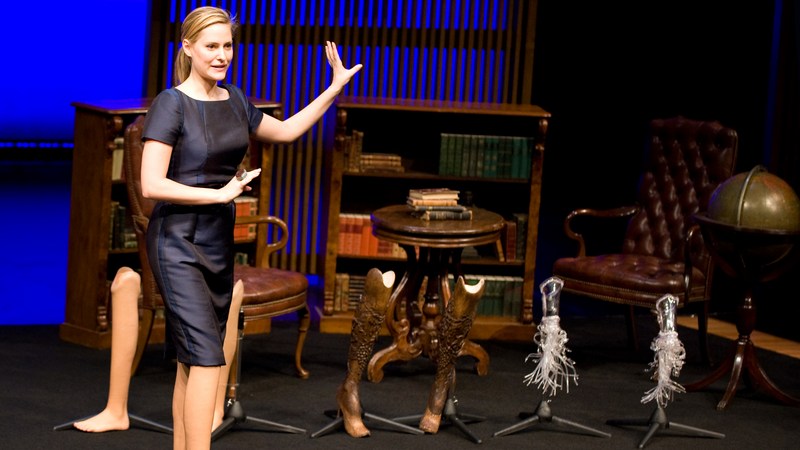
I saw a video of Aimee Mullins, A record-breaker at the Paralympic Games in 1996, Aimee Mullins 
has built a career as a model, actor and advocate for women, sports and the next generation of prosthetics.


She explained her objective to change the mind of people, even to the youngers, to ask at the world what is really the definition of disabled. 

For that, she did a conference to talk about the importance to the art and poetry, to reinvent the prosthetics, to provoque the senses.


I think this woman is incredible, she avanced the project to improve the prothetics science and awake the world about this.

She compared prosthetic legs to eyeglasses, and in the same way that we wear designer eyeglasses she has designer legs (she was wearing her 4-inch heel legs for the talk). She made it clear that with enough attitude you could pull off anything as she left the crowd dumbstruck with her presence.

https://www.ted.com/talks/aimee_mullins_prosthetic_aesthetics/transcript?language=en


mercredi 4 janvier 2017

The roman medicine, Part 2

The big names of the Roman medicine


The history of the Roman medicine is marked by important and famous characters. It is thanks to them that the medicine evolved and spread. These big names of the medicine left an indelible imprint, and today, we still remember them.

First of all, it is important to speak about Hippocrates, even if it is not a Roman doctor: indeed, foundations even of the medicine are owed to him, and the Roman medicine rests widely on its works and discoveries. Hippocrates is an illustrious Greek doctor, born in the island of Cos towards 460 b. J.C. and died to Larissa (city of Thessaly, in the center of Greece) towards 370 b. J.C ..  He is a member of the family of Asclépiades, of priests doctors who assert coming down from Asclépios, Greek god of the medicine and worship him.


Having been the follower of the philosophers Democritus and Gorgias, Hippocrates practises the medicine to Cos and bases the famous school of medicine of the same name there. The medicine was before its works an assembly of religious beliefs. He made a scientific discipline. This is why we nickname him "the father of the medicine" For him the medicine is based on the observation and the reasoning. It is convinced that any disease is caused by an imbalance between four elements: fire, water, air and earth.

He is considered the author of an impressive quantity of medical works, but many of these texts were attributed to him wrongly. Hippocrates is also the author of the oath who bears his name.

---

Asclepiades of Bithynie or Prusa is Roman one doctor of origin Greek born in Prusa (current Turkey) in 124 b. J.C. and died in b av. J.C .. Having studied in Greece, Asclepiades bases a private school of medicine in Rome. It is the first one in the Roman Republic.


According to him, the best way to fight against the disease is to have a healthy lifestyle: he advocates baths, diets, sport, rather than medicine. He denies the theories of Hippocrates and moves forward that his method is the only one to make effect.

---

Aulus Cornelius Celsus is of Roman origin. It is not a doctor but a polygraph (it is an author writing on several sometimes very different subjects.). Contrary to most of the people writing about the medicine, Celse expresses himself and writes in Latin. Celsus is the author of the biggest treaty of medicine of the Antiquity. He resumes all the knowledges accumulated up to there regarding medicine. His work, de re medica, is very well organized. It is only a part of an immense work handling multiple aspects of the Roman company such as the agriculture or the army.

Celse shines with his logic, his common sense and especially with his objectivity: indeed, he never lets show through his preferences through his papers and just brings back the truth such as it is. We consider that Celse lived during the reign of the Emperor Augustus, but it is not absolutely sure.


---

Finally, Claudius Galenus is a Roman doctor of Greek origin been born in Asia Minor, in Pergamon (current Turkey), in 131, and disappeared in 201 in Rome or in Sicily. He is generally recognized as the biggest antique doctor after Hippocrates and as the biggest of Roman Empire.  His father urges him to study of medicine while he is seventeen-year-old. Thus he undertakes in this way and, in 21 years, makes a gigantic journey off the Mediterranean Sea and receives the lessons of big doctors there. He becomes then the doctor of the gladiators to Pergamon. But at 33 years old, the ambitious doctor decides to settle down in Rome. He meets an enormous success there and becomes the doctor deprived of emperor Marcus Aurelius.


But in 167, it is urged to leave Rome. Thus he travels some time before returning in Rome to take care of sons of the emperor. He goes out in 201. Not endowed excessively for the forecast, Galien is very talented on the contrary for the diagnosis. Although studying the philosophy, the pharmacy (domain which he masters well) and the hygiene, the nerve of the medicine of Galien is the anatomy where it makes major discoveries on nerves or blood circulation in spite of some errors (Galien is convinced that it is the liver which is the center of the blood circulation).

He resumes the theory of four elements of his predecessor Hippocrates and is also inspired by Aristote. Contrary to Hippocrates, Galien does not show a modesty and is very full of his person, what many of his colleagues do not appreciate!


Some medical techniques known by Romans

We know now that Romain holds first-rate medical knowledge thanks to the results of big doctors (mixed all the same with errors), and that many specialities already exist at these people. But they are also capable of using sometimes complex techniques. Here are some examples.

The suction cup

An instrument frequently used by the Roman doctors is the suction cup. This tool allows to accelerate the cure of a sick person by appealing to the effect by revulsion, medical process which consists in handling a sick organ, in relieving congestion in him, by causing an influx of blood in a zone distant from the zone to be cured. Having produced a flame inside the suction cup, a partial space builds up itself: we can so inhale the skin and dilate the blood capillaries by placing the suction cup on the skin of the back, the breast … The Roman doctors so cure the pneumonia, the bronchitis, the pains of the back or the stomach … 
We can also practise the heavy loss with an a little bit different suction cup (evacuation of a certain quantity of blood in a therapeutic purpose.) this process totally disappeared today.


The fractures


Romain knows and practise the use of pairs of forceps: they allow the doctor to put back in place the pieces of a broken bone by towing them between crowbars. He can be also used to extract pieces of bones of the body of a patient, or even ... to crush bones or head of a foetus.


The exploration of the body

The speculum suggests the practice of a technique rather close to the endoscopy in Rome. This instrument is rather impressive and called on to an ingenious mechanism which allows to rule out effectively walls. The speculum is a medical instrument which allows to explore more easily a cavity by ruling out its walls, what widens it and the endoscopy is a process using an endoscope ( medical optical instrument), what consists in exploring certain conduits of our body, for example nostrils or bronchi.

The anesthesia

The Roman doctor knows how to anesthetize his patient: for it, he uses substances as the juice of mandrake or the atropine. These products are extracted from the mandrake, from the belladone... 
Remark 
What amazes most when we look closely at the Roman medicine, it is the knowledge which detain the doctors in materials of hygiene: even if they do not know the existence of germs, they clean their instruments after every use, in some boiled water.


To be continued for the part 3


vendredi 9 décembre 2016

The end of free education ?

Marine Le Pen, the leader of the French far-right National Front party has called for an end to free education in France for children of undocumented immigrants.
"I've got nothing against foreigners but I say to them: if you come to our country, don't expect that you will be taken care of, treated (by the health system) and that your children will be educated for free," Le Pen said.

"That's finished now, it's the end of playtime," she told an audience at a conference organised by a polling group in Paris.

Opinion polls suggest the leader of the National Front (FN) will finish second in next year's presidential election but she is hoping for new momentum after Donald Trump's victory in the United States

Speaking to AFP afterwards, she clarified that she wanted to block education for immigrants who are in France illegally, not all foreigners.


Such a move would contravene current French law which guarantees school places for all children.

She also said that any foreigner using the public education system without paying tax in France would have to contribute.

"We're going to reserve our efforts and our national solidarity for the most humble, the most modest and the most poor among us," Le Pen told the conference.

The staunchly nationalist FN sees itself as part of a global revolt against immigration, established political parties and globalisation epitomised by Trump's victory last month.

Its leaders regularly criticise the use of France's chronically over-budget social security system for foreigners, arguing that needy French people should be prioritised.

Le Pen falsely claimed on Thursday that anyone aged over 65 could arrive in France and start claiming old-age social security payments.

Polls currently show her qualifying for the second-round of May's election where she is forecast to face -- and be defeated by -- rightwing Republicans party candidate Francois Fillon.

Few analysts see her as likely to take power, but it has been an unpredictable year in politics and France's sickly economy and immigration are top issues for voters.

The country last ran a federal budget surplus in the 1970s and has a national debt approaching the equivalent of one year's economic output, or 98.4 percent of gross domestic product.

Le Pen wants to withdraw France from the eurozone and has called for a referendum on the country's membership of the European Union.

Illegal and condemned

Trump made controlling illegal immigration a key part of his pitch to American voters, regularly railing against crime committed by foreigners and the country's "open borders."

Immigration was also crucial in swinging Britain's referendum on the European Union in June when many voters backed the Leave campaign to gain control over their borders.

Le Pen's proposals have echoes of plans reportedly drawn up by the interior ministry in Britain in 2015 when it was headed by Theresa May, who is now prime minister.

Leaked documents revealed by the BBC last week showed that her department had argued for immigration checks in schools and suggested headteachers could withdraw places for the children of illegal immigrants.

French Education Minister Najat Vallaud-Belkacem immediately attacked Le Pen's proposal as shameful and unworkable on Thursday.

"With these words, which I condemn with the greatest force, Madame Le Pen proves... her complete indifference to the terrible human circumstances faced by young children," she said in a statement.

She underlined that France guaranteed free education for all school-age children on its territory under its national laws and the international conventions it has signed.

"I remind you that it's a matter of honour for the French republic to guarantee to children, to all children, the right to an education -- in other words, the right to a future," she said.

After a string of terror attacks over the last two years and the biggest refugee crisis in Europe since World War II, hardline rhetoric on immigration is seen as a vote-winner on the right.

Fillon has talked tough on newcomers, promising to reduce immigration to a "strict minimum."


Giraffe extinction

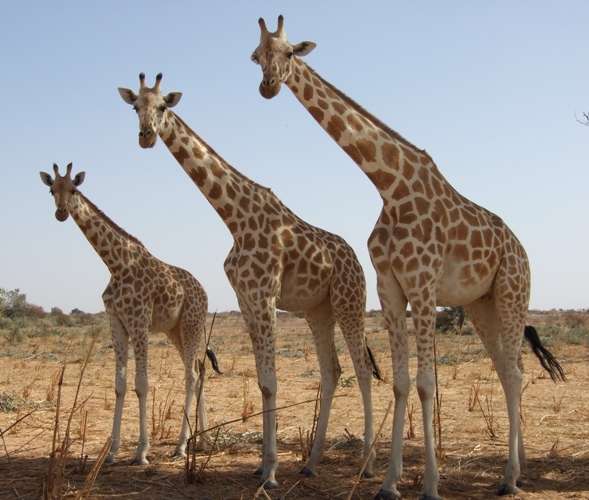
Wild giraffes are not just dropping in numbers at an alarmingly high rate–they’re doing so without much attention from governments and other protective agencies, according to a new report.


The population of wild giraffes has dropped by 40% over the last 15 years, according to a new survey by the Giraffe Conservation Foundation (GCF). The organization calls the problem a potentially “silent extinction” due to a lack of public awareness, which revolves around African elephants, rhinos and gorillas, Mother Nature Network report.

“Giraffes are the forgotten megafauna,” GCF executive director Julian Fennessy told scientific American. “They’re really not getting the attention they deserve.”


The giraffe population has fallen due to habitat destruction by humans repurposing land for agricultural uses, according toMNN. Giraffes have also historically been hunted for their durable, patterned skin, a process that has reportedly increased in Tanzania due to a myth that giraffe brains and bone marrow can cure HIV.

But giraffe conservationists hope the wild giraffe population can be restored with some intervention. When the West African giraffe nearly went extinct in the 1990s due to human causes and droughts, conservationists won legal protection for the animals, and their population has since increased five-fold.